Wednesday, March 12, 2014

Sound - part 1

Sound waves are mechanical - that is, they require a medium.  There can be NO sound where there is no medium through which to travel.  That makes them very different from light (or any e/m waves).

Useful terms in music:

In music, the concept of “octave” is defined as doubling the frequency. For example, a concert A is defined as 440 Hz. The next A on the piano would have a frequency of 880 Hz. The A after that? 1760 Hz. The A below concert A? 220 Hz. Finding the other notes that exist is trickier and we’ll get to that later.

Waves can “interfere” with each other – run into each other. This is true for both mechanical and e/m waves, but it is easiest to visualize with mechanical waves. When this happens, they instantaneously “add”, producing a new wave. This new wave may be bigger, smaller or simply the mathematical sum of the 2 (or more) waves. For example, 2 identical sine waves add to produce a new sine wave that is twice as tall as one alone. Most cases are more complicated.

In music, waves can add nicely to produce chords, as long as the frequencies are in particular ratios. For example, a major chord is produced when a note is played simultaneously with 2 other notes of ratios 5/4 and 3/2. (In a C chord, that requires the C, E and G to be played simultaneously.) Of course, there are many types of chords (major, minor, 7ths, 6ths,…..) but all have similar rules. In general, musicians don’t remember the ratios, but remember that a major chord is made from the 1 (DO), the 3 (MI) and the 5 (SO). It gets complicated pretty quickly.

We looked at specific cases of waves interfering with each other – the case of “standing waves” or “harmonics.” Here we see that certain frequencies produce larger amplitudes than other frequencies.  There is a lowest possible frequency (the resonant frequency) that gives a “half wave” or “single hump”. Every other harmonic has a frequency that is an integer multiple of the resonant frequency. So, if the lowest frequency is 25 Hz, the next harmonic will be found at 50 Hz – note that that is 1 octave higher than 25 Hz. Guitar players find this by hitting the 12th fret on the neck of the guitar. The next harmonics in this series are at 75 Hz, 100 Hz and so on.

Waves!


So - Waves.....  

We spoke about energy.  Energy can, as it turns out, travel in waves.  In fact, you can think of a wave as a traveling disturbance, capable of carrying energy.

There are several wave characteristics (applicable to most conventional waves) that are useful to know:

amplitude - the "height" of the wave, from equilibrium (or direction axis of travel) to maximum position above or below

crest - peak (or highest point) of a wave

trough - valley (or lowest point) of a wave

wavelength (lambda - see picture 2 above) - the length of a complete wave, measured from crest to crest or trough to trough (or distance between any two points that are in phase - see picture 2 above).  Measured in meters (or any units of length).

frequency (f) - literally, the number of complete waves per second.  The unit is the cycle per second, usually called:  hertz (Hz)

wave speed (v) -  the rate at which the wave travels.  Same as regular speed/velocity, and measured in units of m/s (or any unit of velocity).  It can be calculated using a simple expression:


There are 2 primary categories of waves:

Mechanical – these require a medium (e.g., sound, guitar strings, water, etc.)

Electromagnetic – these do NOT require a medium and, in fact, travel fastest where is there is nothing in the way (a vacuum). All e/m waves travel at the same speed in a vacuum (c, the speed of light):

c = 3 x 10^8 m/s

First, the electromagnetic (e/m) waves:

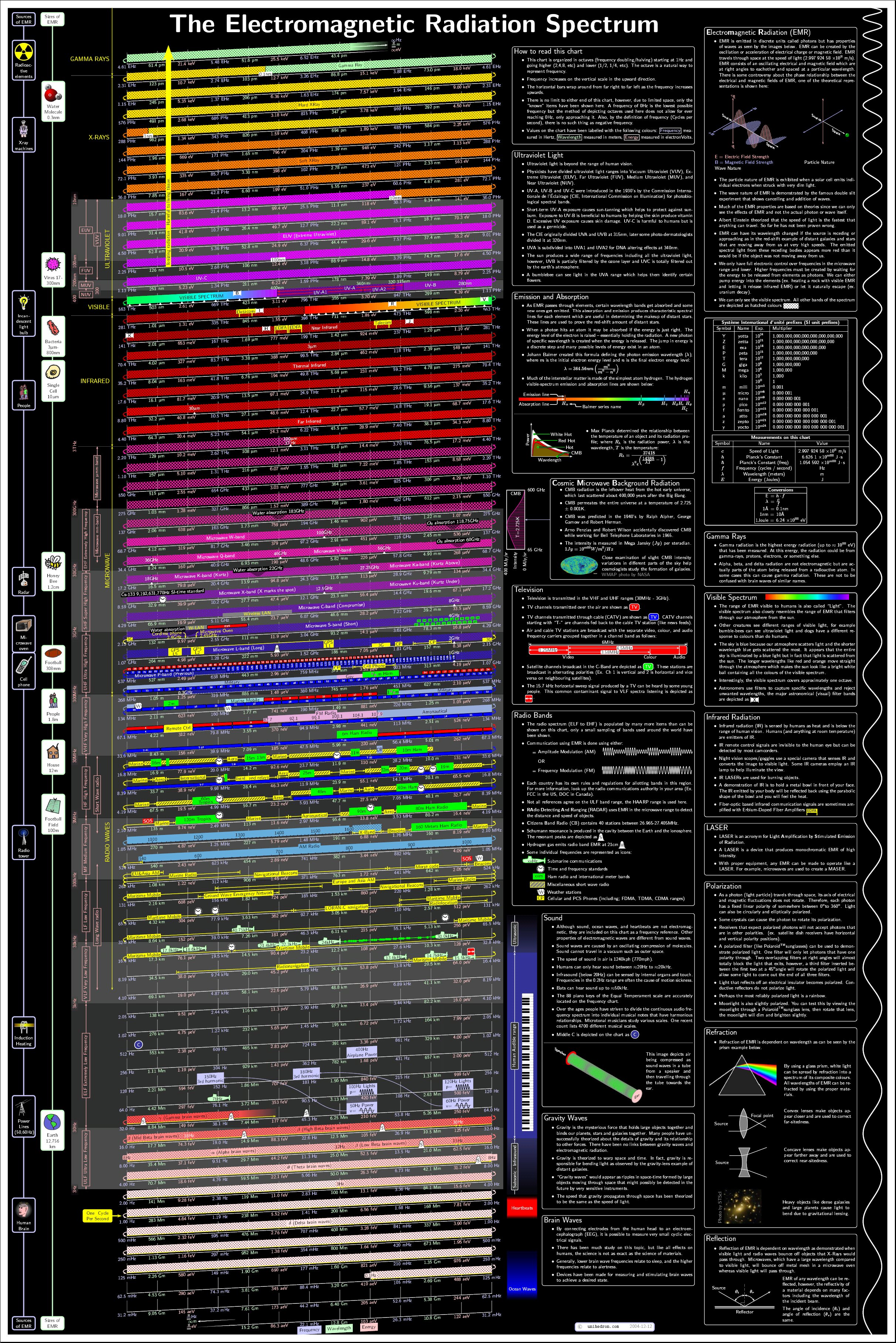
General breakdown of e/m waves from low frequency (and long wavelength) to high frequency (and short wavelength):

Radio
Microwave
IR (infrared)
Visible (ROYGBV)
UV (ultraviolet)
X-rays
Gamma rays

In detail, particularly the last image:


http://www.unihedron.com/projects/spectrum/downloads/full_spectrum.jpg

Mechanical waves include:  sound, water, earthquakes, strings (guitar, piano, etc.)....

Again, don't forget that the primary wave variables are related by the expression:

v = f l


speed = frequency x wavelength

(Note that 'l' should be the Greek symbol 'lambda', if it does not already show up as such.)

For e/m waves, the speed is the speed of light, so the expression becomes:

c = f l


Note that for a given medium (constant speed), as the frequency increases, the wavelength decreases.

Next up - Sound!


Monday, March 10, 2014

Energy

I stole my energy story from the famous American physicist Richard Feynman. Here is a version adapted from his original energy story. He used the character, "Dennis the Menace." The story below is paraphrased from the original Feynman lecture on physics (in the early 1960s).

Dennis the Menace
Adapted from Richard Feynman
Imagine Dennis has 28 blocks, which are all the same. They are absolutely indestructible and cannot be divided into pieces.
His mother puts him and his 28 blocks into a room at the beginning of the day. At the end of each day, being curious, she counts them and discovers a phenomenal law. No matter what he does with the blocks, there are always 28 remaining.
This continues for some time until one day she only counts 27, but with a little searching she discovers one under a rug. She realises she must be careful to look everywhere.
One day later she can only find 26. She looks everywhere in the room, but cannot find them. Then she realises the window is open and two blocks are found outside in the garden.
Another day, she discovers 30 blocks. This causes considerable dismay until she realises that Bruce has visited that day, and left a few of his own blocks behind.
Dennis' mother removes the extra blocks, gives the remaining ones back to Bruce, and all returns to normal.
We can think about energy in this way (except there are no blocks!). We can use this idea to track energy transfers during changes. We need to be careful to look everywhere to ensure that we can account for all of the energy.

Some ideas about energy
  • Energy is stored in fuels (chemicals).
  • Energy can be stored by lifting objects (potential energy).
  • Moving objects carry energy (kinetic energy).
  • Electric current carries energy.
  • Light (and other forms of radiation) carries energy.
  • Heat carries energy.
  • Sound carries energy.

But is energy a real thing?  No.  It is a mathematical concept, completely consistent with Newton's laws and the equations of motion.  It allows us to see that some number (calculated according to other manifest changes - speed, mass, temperature, position, etc.) remains constant before and after some "event" occurs.

Center of Mass (CM)

A very useful concept in physics is Center of Mass (AKA CM, Center of Gravity - they are usually the same point).  

Recall the demo with the mass on a stick.  Same mass, held at a further distance from the "fulcrum", is harder to support.  It twists your wrist more - it requires a greater "torque".

So, what is torque?

Torque - a "rotating" force

T = F L

For an object to be "in equilibrium," not only must the forces be balanced, but the torques must also be balanced.

Consider a basic see-saw, initially balanced at the fulcrum:  See image.

You can have two people of different weight balanced, if their distances are adjusted accordingly:  the heavier person is closer to the fulcrum.  

Mathematically, this requires that the torques be equal on both sides.

Consider two people, 100 lb and 200 lb.  The 100 lb person is 3 feet from the fulcrum.  How far from the fulcrum must the 200 lb person sit, to maintain equilibrium?
Torque on left = Torque on right

100 (3) = 200 (x)

x = 1.5 feet

We call the "balance point" the center of mass (or center of gravity).  

It is the point about which the object best rotates.
It is the average location of mass points on the object.
It does not HAVE to be physically on the object - think of a doughnut.

The principle is believed to originate with Archimedes (287 - 212 BC).  He is believed to have said, "Give me a place to stand on, and I will move the Earth."


FYI:  http://en.wikipedia.org/wiki/Archimedes